
Absolutely. Here’s a complete, copy-paste-ready blog post in a cleaner editorial voice, with a strong heading and SEO-friendly language woven in naturally.
How to Read Jain Art: Cosmology, Sacred Maps and the Meaning Behind the Image
Jain art is one of the most intricate visual traditions in India.
At first glance, many Jain paintings can look almost overwhelming — circles within circles, hundreds of figures, repeated temples, sacred diagrams, meditating Tirthankaras, animals, symbols and entire landscapes compressed into one composition.
But very little in Jain art is there simply for decoration.
A circle may represent an ocean or a continent.
A human-shaped figure may represent the entire universe.
A landscape filled with temples may actually be a pilgrimage map.
A meditating figure at the centre may be the still point around which an entire sacred world is organised.
Once you begin to understand what you are looking at, the work changes completely.
Jain Art as a Visual Language
Jain philosophy has always dealt with some of the largest possible questions.
What does the universe look like?
Where does human life exist within it?
What is liberation?
How is spiritual knowledge understood?
How can something as vast as cosmology be made visible?
Jain artists answered these questions through image.
Cosmological maps, sacred diagrams, mandalas, pilgrimage paintings and Tirthankara compositions became ways of translating philosophy into something that could be seen, studied and contemplated.
This is why Jain art often feels somewhere between painting, map-making and philosophy.
The Jain Universe
One of the most fascinating areas of Jain art is cosmology.
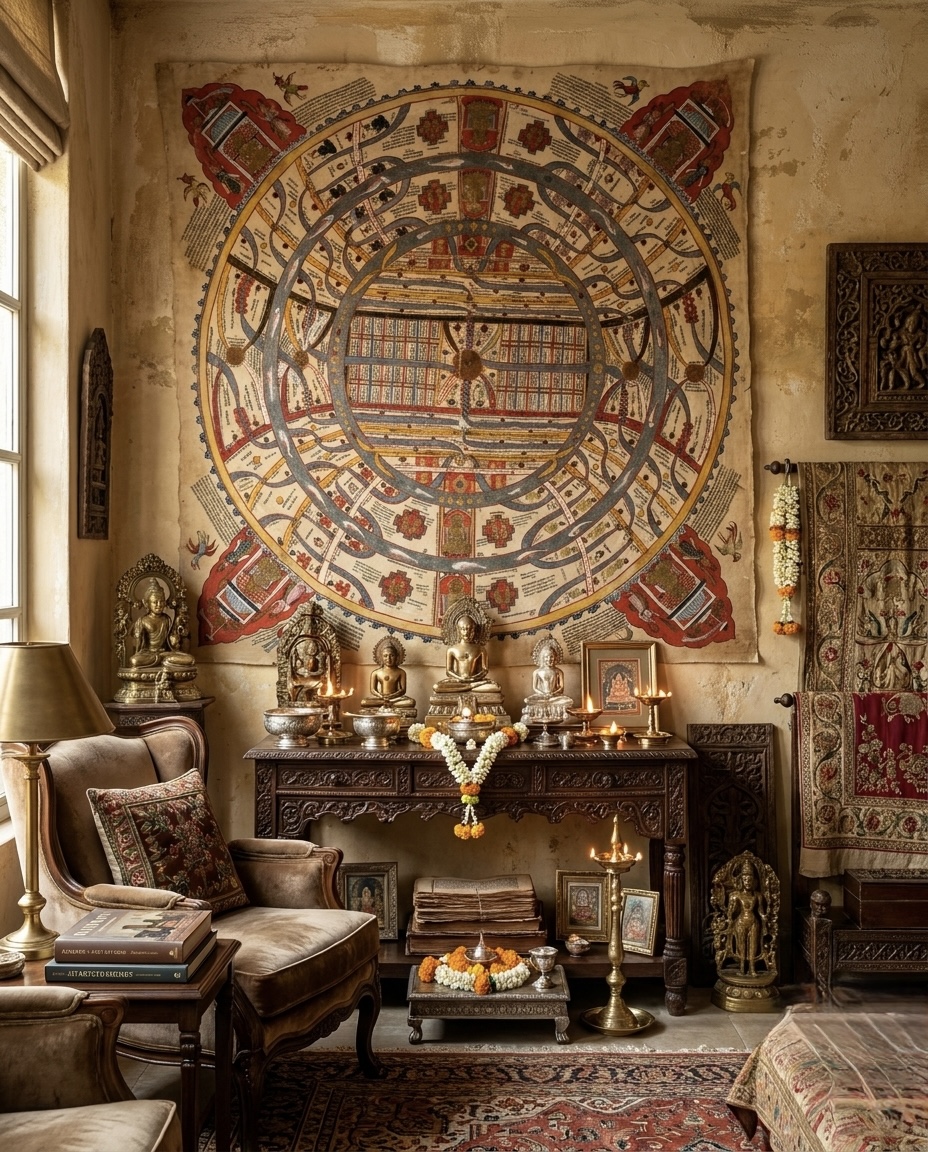
Jain cosmological paintings attempt to show the structure of existence itself. Rather than imagining the universe as an abstract idea, artists gave it form through carefully ordered diagrams.
Many of these works are built through symmetry, repetition and concentric geometry.
At the centre may be Mount Meru, a sacred axis. Around it, continents and oceans expand in rings, creating paintings that can initially appear almost abstract.
They are not abstract.
They are maps of a philosophical universe.
Jambudvipa
Jambudvipa is one of the most recognisable subjects in Jain cosmological art.
It represents the central continent of the Middle World, the realm associated with human existence in Jain cosmology.
In paintings, Jambudvipa is often shown through circular geometry, surrounded by further continents, oceans, mountains, rivers and sacred landmarks.
The extraordinary symmetry of these works is not simply decorative. The structure itself carries meaning.
The painting becomes a way of organising the universe visually.
Adhaidvipa — The Two-and-a-Half Continents
Some Jain cosmological paintings represent Adhaidvipa, meaning the Two-and-a-Half Continents.
These compositions extend beyond Jambudvipa into surrounding regions of the Jain Middle World, creating highly complex circular diagrams filled with geographic and symbolic detail.
The viewer may first notice the pattern.
Then the rivers.
Then the mountains.
Then the sacred figures and architectural forms.
The longer one looks, the more the painting begins to behave like a map.
Lokapurusha
Lokapurusha is one of the most striking images in Jain art.
Here, the universe is imagined through the human form.
The figure itself becomes a cosmic diagram, with different regions of the body corresponding to different realms of existence.
It is important to understand that Lokapurusha is not simply a deity or portrait.
It is a way of giving shape to an abstract philosophical idea.
The universe becomes a body, and the body becomes a map.
That is what makes the image so powerful.
Siddhachakra
The Siddhachakra is another important sacred diagram in Jain tradition.
Unlike cosmological maps, which attempt to show the structure of the universe, Siddhachakra compositions are organised around revered spiritual principles and figures.
They are built through geometry, symmetry and symbolic order.
From a distance, the painting may appear purely decorative.
Up close, it becomes clear that every section belongs to a larger system of meaning.
This is one of the things that makes Jain art so compelling: beauty is often only the first layer.
Samavasarana
The Samavasarana represents the divine preaching assembly of a Jina.
It is imagined as a highly ordered sacred structure where different beings gather around the enlightened teacher.
In paintings, Samavasarana compositions often combine architecture, figures, animals, pathways and sacred geometry within one carefully organised world.
At the centre lies knowledge.
Around it, the world gathers.
That idea gives Samavasarana paintings both visual complexity and philosophical depth.
Tirthankaras
The meditating figures that appear throughout Jain art are Tirthankaras — enlightened beings who have overcome worldly attachment and shown the path toward liberation.
They are often represented with extraordinary stillness.
In many Jain paintings, everything surrounding them may be highly detailed: temple architecture, attendants, inscriptions, symbols, decorative borders and divine figures.
Yet the Tirthankara remains completely calm.
That contrast is one of the strongest visual ideas in Jain art.
The world may be elaborate. The enlightened figure remains untouched by it.
Tirtha Patas — Painted Pilgrimages
Some Jain paintings are not cosmological diagrams at all.
They are pilgrimage maps.
Known as tirtha patas, these works depict sacred sites through temples, paths, shrines, pilgrims and architectural landmarks.
They are not conventional landscapes.
Their purpose is not to show a place exactly as the eye would see it.
Instead, they organise the sacred geography of a pilgrimage.
The viewer can move through the painting visually, shrine by shrine, path by path.
In that sense, the painting itself becomes a way of travelling.
Shatrunjaya and Palitana
Shatrunjaya, at Palitana in Gujarat, is one of the most important Jain pilgrimage landscapes.
Paintings of Shatrunjaya often bring together entire temple complexes, processions, sacred routes and important sites within one composition.
From a distance, the painting may appear as a large landscape.
Up close, it becomes hundreds of individual moments.
A temple.
A pilgrim.
A procession.
A pathway.
Another shrine.
These works reward slow looking because the journey is contained within the detail.
Why Jain Paintings Are So Intricate
The extraordinary level of detail in Jain painting is not simply there to make the work look rich.
The detail often carries information.
A single painting may include:
hundreds of figures
repeated Tirthankaras
temples
animals
rivers
oceans
sacred diagrams
inscriptions
pilgrimage routes
architectural structures
symbolic borders
Each of these elements may contribute to the subject being explained.
This is also why smaller Jain paintings can be especially difficult to execute.
When a complex cosmological or narrative composition is reduced in scale, every figure, line and symbol must become even more precise.
The challenge is not simply painting smaller.
It is preserving the visual language of the subject without losing its meaning.
How to Look at Jain Art
The best way to look at a Jain painting is slowly.
Start at the centre.
What is there?
A Tirthankara?
A mountain?
A sacred diagram?
A cosmic axis?
Then move outward.
Look for circles, borders, temples, animals, inscriptions, pathways and repeated figures.
Look for symmetry.
Look for repetition.
Then move closer.
A work that first appeared to be one image may suddenly break into dozens of smaller scenes.
Jain art rewards attention.
The closer you look, the more it gives back.
Not Every Jain Painting Means the Same Thing
One of the easiest mistakes to make is to call every circular or highly detailed Jain work a “mandala”.
They are not all the same.
Some paintings represent cosmology.
Some depict sacred geography.
Some are pilgrimage maps.
Some focus on Tirthankaras.
Others organise spiritual principles through diagrams such as Siddhachakra.
Two works can appear visually similar and still represent very different ideas.
Understanding the subject matters.
Jain Art at Claome
At Claome, our interest in Jain art begins with the subject itself.
Before looking at a work simply as an object for a wall, we try to understand what the image is actually showing.
Is it Lokapurusha?
Jambudvipa?
A pilgrimage map?
A sacred diagram?
A Tirthankara composition?
The more we learn about these works, the more fascinating they become.
That is what we want to share with collectors.
Jain art is not only about extraordinary detail.
It is about the ideas held inside that detail.
Painted by Hand
The Jain works at Claome are hand-painted, with technique and material varying according to the composition and artist.
Dense cosmological diagrams, repeated figures, fine architectural details and miniature forms demand enormous precision.
Because of this, many works are created in limited numbers or made on order.
Selected works from ₹5 lakh.
Collecting Jain Art
You do not need to understand every symbol before connecting with a Jain painting.
Sometimes the connection begins visually.
You may be drawn to the geometry of Jambudvipa.
The human form of Lokapurusha.
The stillness of a Tirthankara.
The complexity of a pilgrimage map.
The meaning can come later.
For collectors considering a Jain work for a particular space, Claome can suggest compositions according to subject, scale and visual language.
Speak to the Curator
There Is Always More to See
Jain art is the kind of art that changes as your understanding deepens.
The first time you see the painting, you notice the image.
The next time, the structure.
Then the symbols.
Then the philosophy behind them.
And eventually, what looked like a painting begins to feel like an entire world.
Explore Jain Art at Claome.